
Callibrity Product Practice
A repeatable system for building a Product practice from zero, proven twice
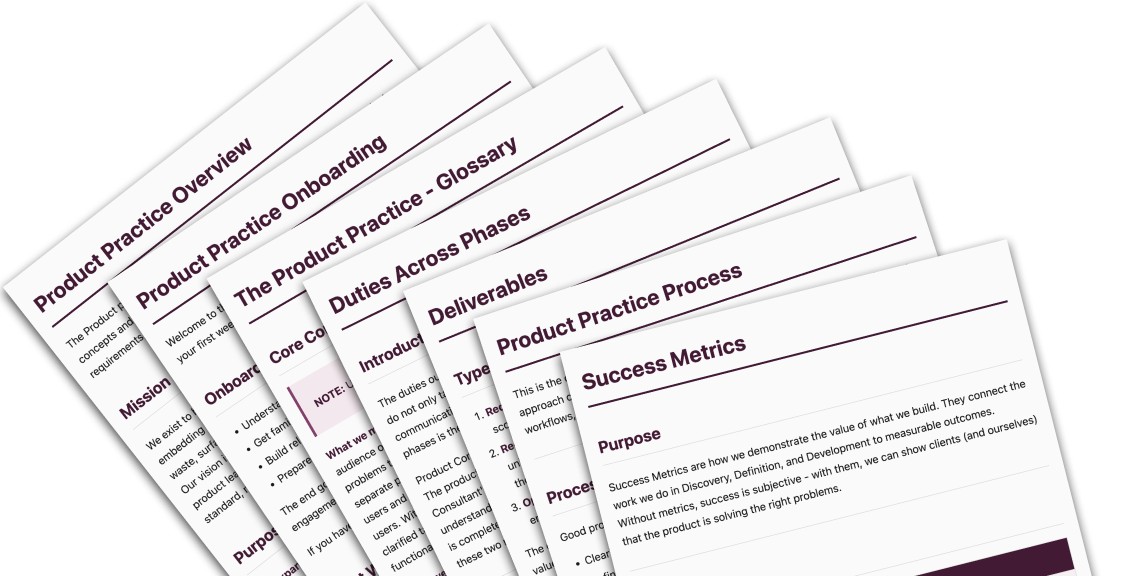
Overview
I have a repeatable process for taking a Product or UX team from zero to one. At Bitovi, I rebuilt an existing team. At Callibrity, there was no practice in place before I started, so I built one from scratch, including the AI-acceleration layer.
Role
Director of Product
Timeframe
November 2023 - present
From UX Department to Product Practice
Callibrity hired me in November 2023 to build out a UX Practice, UX capabilities they were missing in their offering. I proposed something different instead: a Product Practice where a product-minded consultant and a technical lead work together from day one, merging what stakeholders want and what users need with what’s technically feasible, instead of only thinking about the user once there is a build to present to them. I named the team the “Product Practice,” a naming call I wanted to get right here after learning a lesson at Bitovi. People outside UX, including many clients, already conflate the practice with visual interface design. Calling the team a Product Practice puts that conversation in front of it before it can happen.
None of that meant giving up UX methodology, the research, the requirements work, understanding what a user actually needs. It meant practicing it as an owner of the outcome rather than a service consulted on request, using it to solve problems aligned with the client’s business goals and the user’s actual needs at the same time.
Building the Team
I grew the practice from one consultant, me, to a team of nine. Callibrity’s recruiting team sourced candidates; I sat in on every interview and made the final call on every hire, a division of labor that let me spend my time on judgment instead of pipeline.
On several early engagements, I ran discovery myself while we were still hiring to staff the work, then handed the plan to whoever we brought on once the biggest unknowns were resolved. That gave new hires a validated plan to build from instead of a blank page.
Building the Infrastructure a Practice Runs On
Weighing stakeholder wants, user needs, and technical feasibility together, instead of treating any one of them as the whole answer.Ryan Wilson
None of the practice’s infrastructure existed before I got there. I built it around an approach I’d been refining since grad school and years of client work before Callibrity: weighing stakeholder wants, user needs, and technical feasibility together instead of treating any one of them as the whole answer. I adapted Callibrity’s existing developer career ladder into a Product-specific version, and rebuilt the quarterly review process to align with it. The old system was a flat five-point scale, essentially bad to good, and self-rated. My version ties expected performance to a defined tier instead: associate, mid, senior, staff, senior staff, principal, so it can actually show whether someone is performing at, above, or below their level, which is what a real case for a title change depends on.
I’ve also rebuilt my interview approach: I built baseline scenarios for each level on the ladder, and I adjust or add follow-up questions based on how a candidate answers, to level them more accurately as the interview goes instead of relying on gut feeling. In testing so far, it consistently catches what gut-feel, or just taking a candidate’s word for their own level, misses: a candidate’s strongest skill masking a weaker one, and the gap between how someone rates themselves and what the interview evidence actually shows. Time in a title isn’t the same as expertise; I’ve seen plenty of people coast through a career and get leveled up for attendance, not performance.
Bringing my Playbook to Callibrity
At Callibrity, I introduced a tiered set of entry offers I’d already built, letting a prospective client buy into progressively more commitment as trust builds:
- A one-to-two-hour first-look review report
- A half-day workshop
- Four 30-minute user interviews
- A full six-week Discovery engagement
Discovery should produce 75-85% confidence in the recommendation that we’re solving the right thing, not certainty. Getting there takes the full six weeks, not less; there’s no shortcut to that level of confidence, and chasing full certainty beyond it is a waste of time and money. The point is knowing you’re building the right thing before you spend the effort to build it right. From there, the engagement moves into a development phase, where a Product Consultant stays involved throughout the engagement.
My first Independent Contributor project at Callibrity, the Honda HALO engagement, proved the model: identifying the client’s real need quickly, producing reporting materials that helped them decide to move forward, and turning a short discovery engagement into a longer build, a genuine land-and-expand.
Leading AI Enablement, For Real
“AI accelerates the work. It doesn't get to make the decisions that are the humans' to make.”Ryan Wilson

AI went from a talking point to daily practice during my time at Callibrity. There was chatter about ChatGPT and early experiments with Midjourney when I started in 2024; both showed real value but weren’t reliable enough yet to build a standard around. By 2025, building CHIRP Radio’s front end, I had the first real proof under real conditions: I built the entire production front end myself, wrapped in Capacitor for iOS and Android with native Kotlin and Swift components, over a build that took considerably longer than it would today, since I was still finding the edges of what the tool could actually do reliably.
I authored the practice’s AI-enablement standard from that experience and led its rollout company-wide, not just on the Product team, built around one rule: AI accelerates the work, but it doesn’t get to make the decisions that are the human’s to make. The standard runs through the actual chain of product artifacts: a consultant sketches a product flow by hand, then hands it to AI to build natively in FigJam, real shapes and connectors, in minutes instead of hours. A human who knows the product validates that flow before it goes any further; only then does it become the grounded input for a wireframe, and the wireframe for a click-through prototype. Minutes to hours, work that used to take weeks, and at every step the human’s thinking is the input and AI’s job stays mechanical production, never invention.


Every decision and open question behind that work gets logged the same way, in real time, in the client’s shared brain: what was decided, why, who decided it, what else was considered, and what it was based on. That last part is the one people skip, and it’s the difference between a record that just looks official and one a team can actually rely on months later. The payoff shows up at handoffs: a consultant can roll off an engagement and the successor onboard entirely from that log, dozens of decisions with rationale intact, open questions transferred by name, oriented within minutes of picking up the project. That’s what makes the standard real: repeatable, teachable, and it outlasts any one person on the account.

I built that standard into two trainings for the team. “Land and Expand” sets the expectation for every consultant that the trust you build and the expertise you show is what lands new opportunities at an existing client: more phases, more resources, work the client hadn’t planned on until they saw what we could do. “Discovery for Devs” teaches developers what a real discovery actually covers, beyond reviewing a client’s tech stack and database architecture, and what’s expected of the tech lead during one: write, take notes, and attend every meeting together with your paired product consultant, bringing them into technical meetings and getting brought into things like user observations, so everyone brings their own expertise and can ask questions from their own experience.

The principle underneath all of it hasn’t changed since long before AI entered the picture: stay ugly as long as possible, because polish makes people trust a solution before it’s earned that trust (the aesthetic usability effect), and I don’t want visual polish distracting from whether the problem is actually solved. AI just makes it faster to move between fidelity levels once the thinking is done.
By 2026, on a compressed client-portal engagement, that same discipline extended to code.
I built a repeatable process for getting production-ready code out of AI, not a personal coding trick: a Figma-paired, Storybook-documented component library, built in about three days, tokens first, then components built atomically and reviewed the way any other engineering work would be, each one bound to a token instead of a hardcoded value. That upstream discipline, not the AI itself, is what let that library and Claude Code turn into that project’s entire production front end in twelve hours; garbage components in, garbage code out, and the speed only shows up once the foundation actually holds. That’s what convinced developers who didn’t believe AI could produce production-ready code: the discipline behind the component library, not coding skill, is what the AI’s output actually depends on. It’s reproducible and teachable, not a one-off trick.

Staying Current
I helped start and ran Callibrity’s internal podcast, The Forward Slash, as Director and Producer, involved from the start. Starting in May 2025, our topics turned almost entirely to AI, because that’s what the rest of the industry wanted to talk about. Producing and recording those episodes with our CTO and the guests we brought on was as much an education for me as it was content for anyone else, a second, ongoing channel for staying current that ran alongside the client work itself.

Where the Practice Stands Now
The approach behind this practice isn’t specific to Callibrity. It comes from things I’ve learned over a career, proven now at two different companies, not a one-time result of the right team or the right timing.
The practice today runs nine Product Consultants, each engaged on a client contract, and is in the middle of an ongoing AI-training push that includes pursuing Anthropic certifications. The clients below, and the case studies linked here, are what it’s produced so far.
Clients I Worked With
- Honda HALO
- FlyWire
- GE Aerospace
- CHIRP Radio
- FEG
- Town of Cary