
Menu Management Tool
Creating a menu tool for Pizza Hut, Taco Bell, & KFC
Overview
Bitovi's CEO picked me to join him as a two-person team for Yum! Brands: I came on as Product Owner and UX Consultant, he led the technical side, and our job was to identify what an enterprise menu management tool (MMT) for Taco Bell, KFC, and Pizza Hut actually needed to be. Each brand had its own legacy MMT, glossary, and process for updating data, so I observed and researched how each one actually worked, listened to users and stakeholders across all three, and used that to recommend solutions that would hold up across all of them instead of favoring one brand's process over another.
Role
Product Owner & UX Consultant
Scope
Two years; joined as part of the two-person founding team
Tools
Research, Observation, Workshops, Documentation, Presentation, Usability Testing, Sketching, Figma, Axure, Zeplin
Approach
Problem Statement
Taco Bell, KFC, and Pizza Hut each ran their own legacy MMT, with its own glossary and process for updating menus, pricing, taxes, and store data, so the same kind of change meant three different systems, three different vocabularies, and three separate teams' worth of process to account for. Yum! needed one tool that worked for all three without forcing any brand into another's workflow, built to extend internationally in later phases.


Goals
- Identify what an enterprise MMT needed to do for Taco Bell, KFC, and Pizza Hut, replacing three fragmented brand-specific systems with one
- Build a single-source product flexible enough for many different user types across all three brands
- Set up the data model so it could feed brand apps, ecommerce (like KFC.com), and in-store back-of-house/POS systems without per-brand rework
Process
Consolidating three separate, brand-specific MMTs, each with its own workflow and vocabulary, meant first understanding what those differences actually were, not assuming they'd be minor. I built a source-of-truth repository to hold that documentation, then observed Data Managers at each brand step through their process, surfacing the pain points and inconsistencies a single tool would need to resolve.
That research became a persona deck representing the product's range of users, and from there, user stories, refined product flows, and tickets groomed with the business analyst, all vetted with developers to align on when and how each piece would get built.
- Product Flows
- Sketches
- Wireframes
- Design System
- Mockups
- Prototypes
- Usability Testing
- Iteration & Refinement
Findings
Cross-brand workshops with stakeholders from Yum! and all three brands became the mechanism for aligning timelines and requirements, since defining a single product meant accounting for every brand's use cases without shortchanging any of them.
Keeping that alignment across pods meant surfacing gaps early and helping shape sprint planning. While other product owners drove their own pods, my lane was research, stakeholder alignment across all three brands, and directing the Admin plan those brands would share.
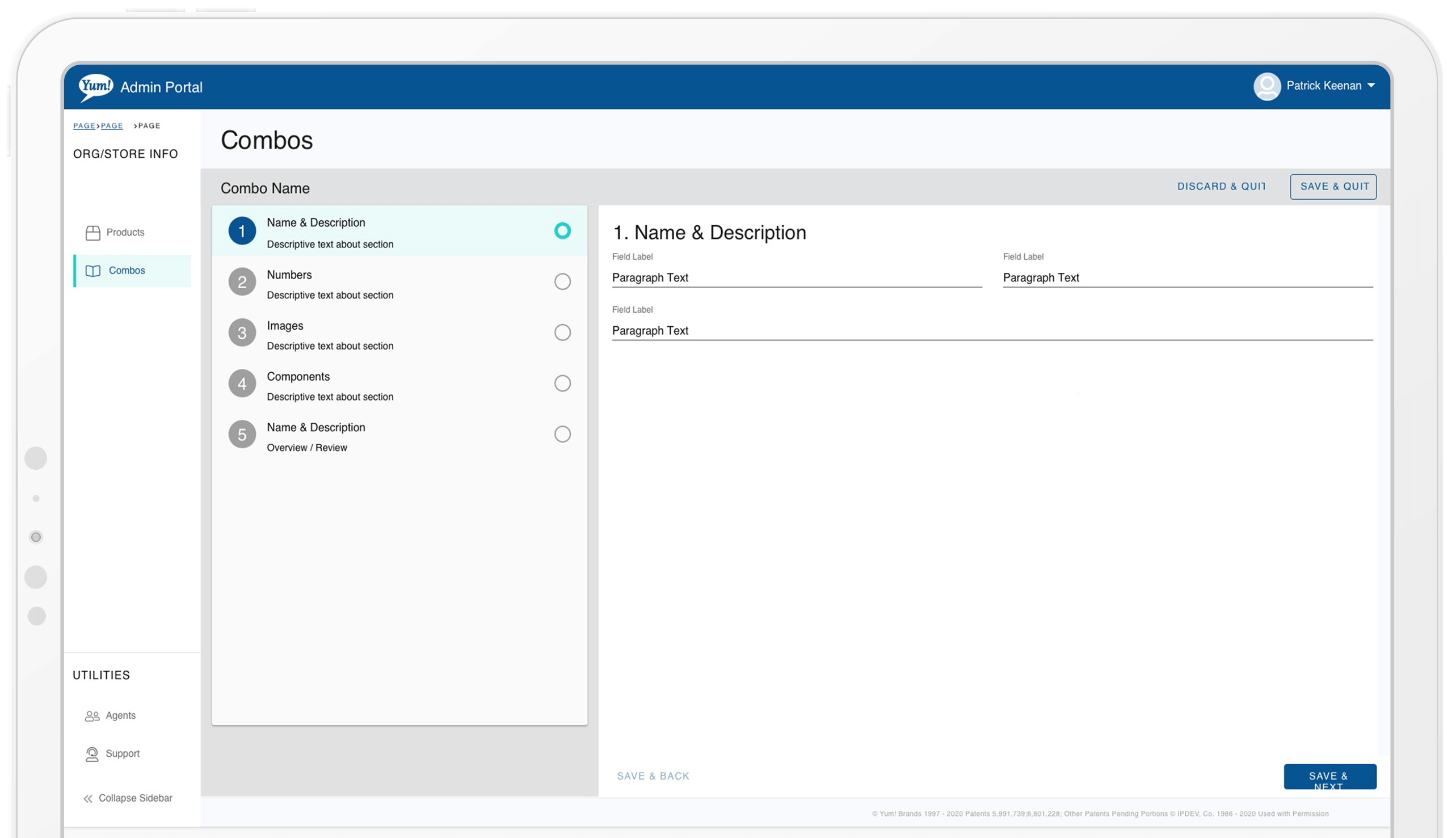
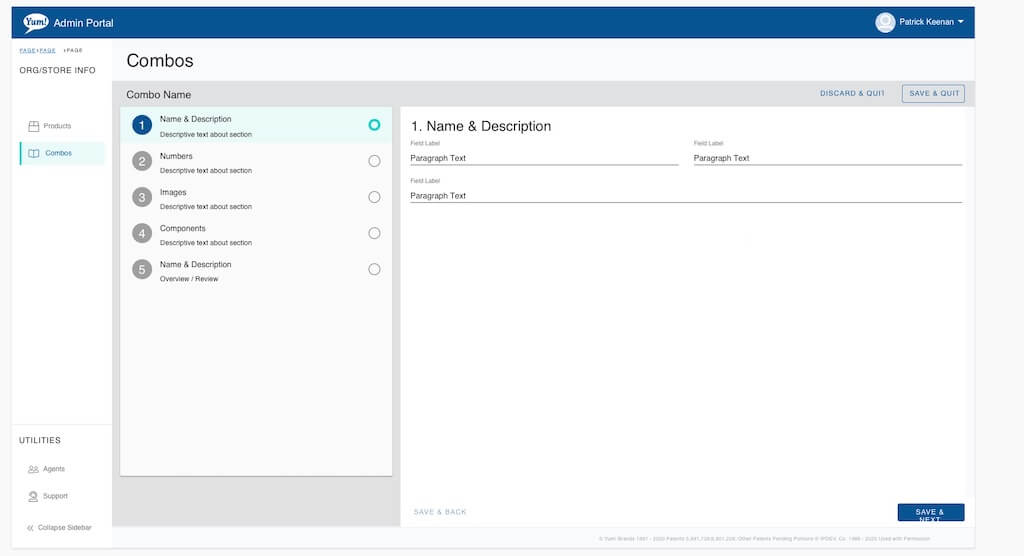
On the interface side, I built common interface patterns utilizing Material UI and turned them into wireframes developers could build from directly, then closed the loop with usability testing and QA to confirm what shipped matched what was designed.


Solution
Many of the MMT features I designed are in production across all three brands, simplifying a previously fragmented process, reducing onboarding time for new team members, and unifying how each brand manages its data. The product continues to scale with the needs of stakeholders and users.
Impact
Results
- Defined feature timelines for the MMT product with stakeholders across all three brands
- Created documentation to live as a central source of truth and support project onboarding
- Defined initial interface patterns for the MMT product
- Assisted in sprint planning, writing user stories, and pulling together resources for issues
- Developed concepts for the complex Tax Logic Builder feature
- Built Yum.dev's UX hiring plan, supported recruiting and interviewing, and mentored new hires
Achievements
Getting Taco Bell, KFC, and Pizza Hut to agree on a shared language and process for maintaining menus, pricing, and store data was the core of this engagement, and it's work I drove through research, stakeholder alignment, and direction of the Admin plan that still runs and grows today.- Researched the existing process across all three brands, aligned stakeholders on a shared direction, and documented and directed the single-source Admin plan for menus, products, deals, coupons, store details, depletion information, and cross-brand customer support, still running in production for Yum! today
- Defined and improved product flows through the system
Takeaways
What would I do differently?
The interface ran on Material UI, per developer preference. It's a fine library, but I think it limited our pattern design. If I could do this again, I would have created a custom design system and component library with no dependencies instead, for more flexibility as the patterns and design elements grew over time.
How did I grow?
This project reinforced something I later wrote about: the value of staying comfortable with ambiguity. It was massive, with a lot of information to capture, understand, and organize, and the connections between concepts weren't always apparent in the short term.
In my career, I've frequently had stakeholders tell me their product "was for everyone." The Yum! MMT was the first time I saw that actually be true. Understanding every potential user type, the tasks they'd perform, and the interaction patterns available in each scenario mattered, and having an organized design system was what let the team align on solutions.