
Bitovi UX Department
The first proof that a Product or UX practice can be built from zero, deliberately
Overview
I joined a five-person Design Team in 2016 and was asked to help migrate its practices to more of a UX standard. When the team’s previous director left, the team had dwindled to two people, including myself. I was asked to take the team over in 2019. I rebuilt it deliberately, headcount and infrastructure at the same time, growing it to ten people and from $1M to $2.5M in UX sales in two years, while keeping utilization above 90% the whole way.
Role
Director of User Experience
Timeframe
June 2019 - August 2021
Taking Over a Team of Two
I joined Bitovi in May 2016 as an individual contributor on an existing five-person design team and was asked to support the team’s training and recruiting. In June 2019, the team’s director left and the team had shrunk to two people, including me. I was asked to lead the team, and I accepted on the condition that we rebrand from “Design Team” to “UX Department”. Becoming director meant scaling the recruiting approach that had already been working, not changing direction.
Rebuilding, Deliberately
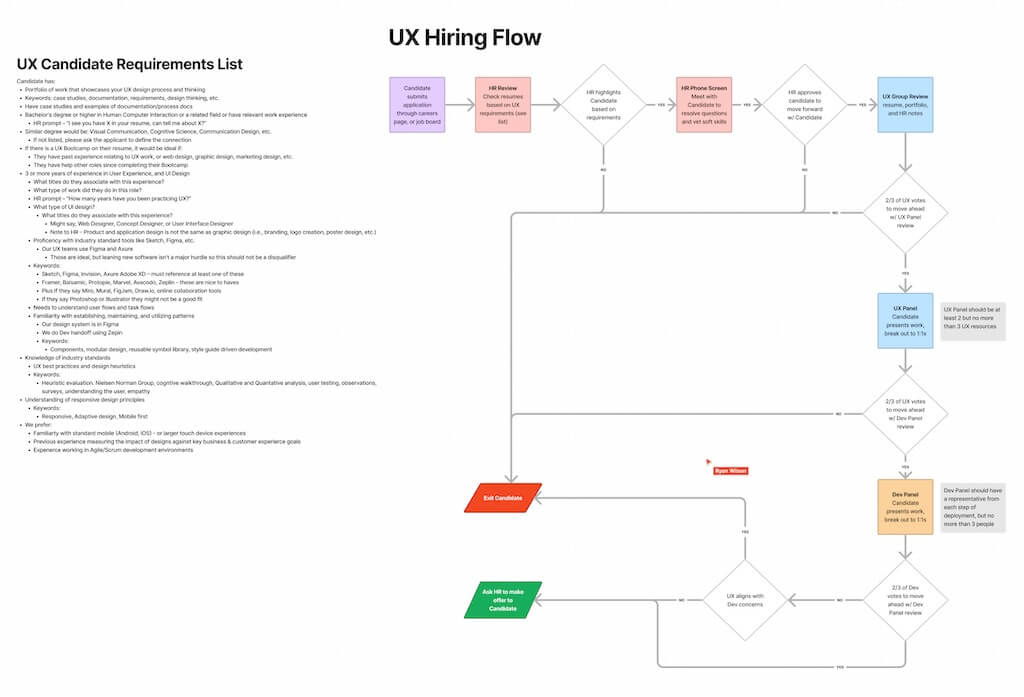
I recruited senior-level UX talent and grew the team up to six within the first year and to ten by the time I left the company in August 2021.

Alongside that hiring, I created a team charter and built our onboarding process: when someone started, they took an assessment to gauge where they’d need training and support for their growth, and I supported training to address the gaps that surfaced, including usability testing and other UX processes.

I also worked deliberately on team culture and values as we scaled, and supported UX sales calls and project proposals, since growing the department meant growing the business case for UX within the company.
Changing How the Team Was Engaged
Part of rebuilding the team was also advocacy: changing how the practice was engaged and perceived, leading with discovery alongside a Tech Lead before anything was estimated or built, and rebranding to a “UX Department” to get out from under the assumption that UX is a synonym for visual design. I’ve written more about both of those, why I think a lot of what passes for UX work at big-box consulting firms has become theater: long discoveries that produce nothing but a bloated slide deck for the client to decode, oversized workshops, personas invented instead of researched, journey maps built without ever observing a real user, work that costs clients time without building any real confidence in what to build, and why UX isn’t a synonym for visual design.

What It Grew Into
By the time I left in August 2021, the department had grown from two people to ten, with UX engaged at discovery on client work rather than brought in after the fact.
That revenue growth held quarter over quarter, not just year over year. The hiring and onboarding processes built here were later reused to help client teams, including Yum! Brands, build their own UX teams.
What I’d Do Differently
If I could go back and do one thing differently, it would be naming the team the “Product Department” rather than the “UX Department.” Donald Norman coined the term “User Experience,” but I don’t believe he ever intended it to be a separate practice; I think he meant it to be part of how a product person thinks about the user from the beginning of problem-solving. Calling it the “UX Department” reinforced UX as its own silo rather than something integrated into product thinking. I carried that lesson forward when I started my team at Callibrity, naming it the “Product Practice” from the start.
Where the Habits Came From
I had been managing teams for about fifteen years before I took this one over, and I got better at it here. I managed my own recruiting throughout, which I think is a key reason the team was as successful as it was. Some of what I brought to bear predates Bitovi: staying ugly as long as possible, not letting visual polish get ahead of whether the problem is actually solved, and a table-of-contents and process-documentation methodology I’d started back in grad school, for keeping project documentation and the iterations of artifacts organized as a project moves. Other habits I built here and still use today: First Look Reviews, a real-time, documented heuristic analysis; a formalized six-week discovery engagement; and being the closer on sales calls and writing the Statements of Work that won the work.
Clients I Worked With
- HaulHound
- Apple
- Yum! Digital
- Pizza Hut
- Taco Bell
- KFC
- Lowe's
- Johnson & Johnson
- The Winklevoss Twins